

2025
Wayback: AR-Integrated Product Design
Memory and wayfinding support in Assisted Reality with Meta Glasses.
Assisted Reality
Wayfinding
Contributions
Role: UX Researcher and Co-Designer
Team: Maddison Manente, Stephanie Reed, Cameron Thompson, Erica Flora Yu
Timeline: Fall 2025 ~8 Weeks
Tools: Figma, Adobe After Effects, Meta AR/VR Component Sets, FigJam
Contributions
Role: UX Researcher and Co-Designer
Team: Maddison Manente, Stephanie Reed, Cameron Thompson, Erica Flora Yu
Timeline: Fall 2025 ~8 Weeks
Tools: Figma, Adobe After Effects, Meta AR/VR Component Sets, FigJam
The Problem
Wayfinding in Urban Environments for Individuals with Memory Loss
For individuals with short-term memory loss, brain injuries, or early-stage dementia, a simple trip to the pharmacy can become a source of profound distress. Traditional navigation tools often rely on "bird’s-eye view" maps, which our research showed are significantly harder for cognitively impaired users to process.
When users become disoriented in dense urban environments, they experience more than just a wrong turn—they experience shame and a loss of autonomy.
The Problem
Wayfinding in Urban Environments for Individuals with Memory Loss
For individuals with short-term memory loss, brain injuries, or early-stage dementia, a simple trip to the pharmacy can become a source of profound distress. Traditional navigation tools often rely on "bird’s-eye view" maps, which our research showed are significantly harder for cognitively impaired users to process.
When users become disoriented in dense urban environments, they experience more than just a wrong turn—they experience shame and a loss of autonomy.
Understanding the User
Designing for User Autonomy
A primary goal of my design leadership was ensuring the interaction model was non-belittling. We implemented a three-tiered input strategy to ensure the user felt in control regardless of their environment.
Understanding the User
Designing for User Autonomy
A primary goal of my design leadership was ensuring the interaction model was non-belittling. We implemented a three-tiered input strategy to ensure the user felt in control regardless of their environment.
Bird's-Eye View Maps Fail
Users with Mild Cognitive Impairment (MCI) struggle to link landmarks to top-down maps.
The "Crossroad" Struggle
Decision points at complex intersections cause the highest levels of anxiety.
The Need for Discretion
Users expressed a desire for assistance that doesn't "look" like a medical device to avoid public stigma.
The Hardware
Meta RayBans Glasses
A primary goal of my design leadership was ensuring the interaction model was non-belittling. We implemented a three-tiered input strategy to ensure the user felt in control regardless of their environment.
The Hardware
Meta RayBans Glasses
A primary goal of my design leadership was ensuring the interaction model was non-belittling. We implemented a three-tiered input strategy to ensure the user felt in control regardless of their environment.


Hand Controls
Standard hand gestures can help users navigate WayBack's routing system. Pinching index and thumb for "YES," middle finger and thumb for "NO," index finger run over thumb to scroll.
Glasses Overview
Using the Neural Band, people can identify intuitive hand gestures for easier travelling through busy urban spaces.
Design Theory
From Mantras to Mental Cues
A primary goal of my design leadership was ensuring the interaction model was non-belittling. We implemented a three-tiered input strategy to ensure the user felt in control regardless of their environment.
Design Theory
From Mantras to Mental Cues
A primary goal of my design leadership was ensuring the interaction model was non-belittling. We implemented a three-tiered input strategy to ensure the user felt in control regardless of their environment.

Voice
Quickest way to set a task: "Hey Meta, take me to CVS."
Used at home or in private.

Tap
Subtle interaction with the glass frames for users who don't want to speak aloud.
Used in public/quiet spaces.

Neural Band
Hand gestures (Pinch for "Yes/No") that allow the user to respond to reminders without anyone noticing.
For maximum discretion.
User Interface
Core Features
These interface patterns are built to guide the user without making them feel watched or judged.
User Interface
Core Features
These interface patterns are built to guide the user without making them feel watched or judged.
1. Directional
AR Arrows
Instead of a map, WayBack uses simple arrows on the ground to guide the user. If the user faces the wrong way, an arrow indicating that the user should make a U-turn appears to guide them back to their path.

2. The Wandering Reminder
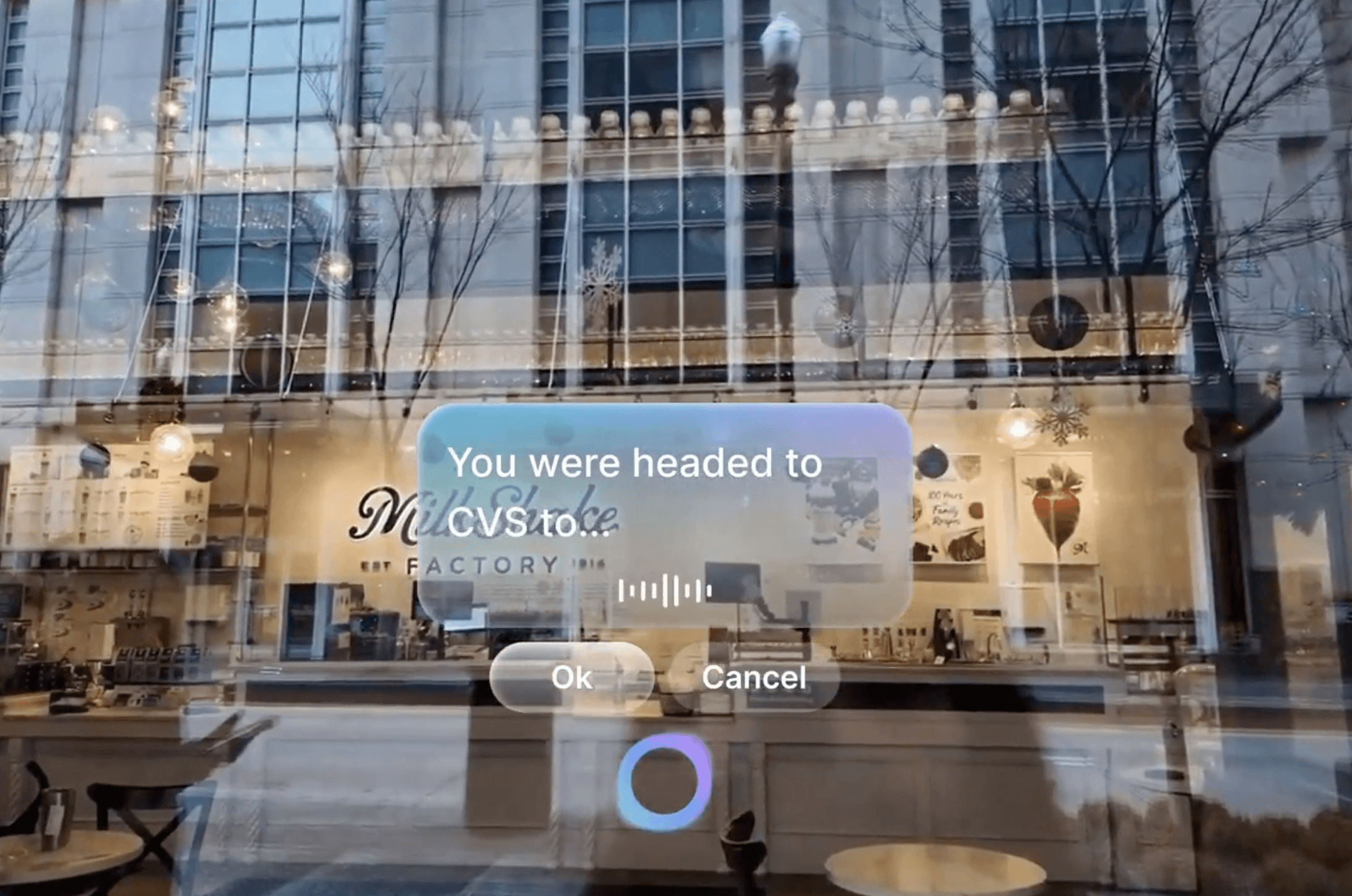
If the system detects the user has deviated from the route or stopped for an extended period, it asks: "Would you like a WayBack reminder?" This uses non-judgmental language to help the user re-orient without feeling "watched."
Task Playback
If the system detects the user has deviated from the route or stopped for an extended period, it asks: "Would you like a WayBack reminder?" This uses non-judgmental language to help the user re-orient without feeling "watched."

Safety
Feasibility & Ethical Guardrails
Safety
Feasibility & Ethical Guardrails
Battery Management
WayBack includes a "Route-Based Battery Indicator." If the glasses don't have enough charge to complete a trip, the user is notified before they leave.
Language Tone
We meticulously edited prompts. Instead of "Why are you going there?", we used"Would you like to add a task?" to maintain user autonomy.
Privacy
All location data is processed with encrypted local processing.
Reflection
Success Metrics
If tested today, success for WayBack wouldn't just be measured by "faster time-to-destination." It would be measured by:
1. Increased Independence: The user’s confidence in leaving their home alone.
2. Reduced Cognitive Load: Lowering the need for "mantra-style" repetition.
3. Dignity: The user’s ability to receive help without experiencing the shame often associated with visible assistive technology.
Reflection
Success Metrics
If tested today, success for WayBack wouldn't just be measured by "faster time-to-destination." It would be measured by:
1. Increased Independence: The user’s confidence in leaving their home alone.
2. Reduced Cognitive Load: Lowering the need for "mantra-style" repetition.
3. Dignity: The user’s ability to receive help without experiencing the shame often associated with visible assistive technology.
Final Deliverables


More Works

FAQ
01
What kind of work are you looking for?
02
What makes your approach different?
03
Do you research or just design?
04
How do you work with AI?
05
Why is some of this academic work?
06
Can you actually build, or only design?
07
What tools do you work in?
08
How do I reach you?
2025
Wayback: AR-Integrated Product Design
Memory and wayfinding support in Assisted Reality with Meta Glasses.
Assisted Reality
Wayfinding
Contributions
Role: UX Researcher and Co-Designer
Team: Maddison Manente, Stephanie Reed, Cameron Thompson, Erica Flora Yu
Timeline: Fall 2025 ~8 Weeks
Tools: Figma, Adobe After Effects, Meta AR/VR Component Sets, FigJam
The Problem
Wayfinding in Urban Environments for Individuals with Memory Loss
For individuals with short-term memory loss, brain injuries, or early-stage dementia, a simple trip to the pharmacy can become a source of profound distress. Traditional navigation tools often rely on "bird’s-eye view" maps, which our research showed are significantly harder for cognitively impaired users to process.
When users become disoriented in dense urban environments, they experience more than just a wrong turn—they experience shame and a loss of autonomy.
Understanding the User
Designing for User Autonomy
A primary goal of my design leadership was ensuring the interaction model was non-belittling. We implemented a three-tiered input strategy to ensure the user felt in control regardless of their environment.
Bird's-Eye View Maps Fail
Users with Mild Cognitive Impairment (MCI) struggle to link landmarks to top-down maps.
The "Crossroad" Struggle
Decision points at complex intersections cause the highest levels of anxiety.
The Need for Discretion
Users expressed a desire for assistance that doesn't "look" like a medical device to avoid public stigma.
The Hardware
Meta RayBans Glasses
A primary goal of my design leadership was ensuring the interaction model was non-belittling. We implemented a three-tiered input strategy to ensure the user felt in control regardless of their environment.
Hand Controls
Standard hand gestures can help users navigate WayBack's routing system. Pinching index and thumb for "YES," middle finger and thumb for "NO," index finger run over thumb to scroll.
Glasses Overview
Using the Neural Band, people can identify intuitive hand gestures for easier travelling through busy urban spaces.
Design Theory
From Mantras to Mental Cues
A primary goal of my design leadership was ensuring the interaction model was non-belittling. We implemented a three-tiered input strategy to ensure the user felt in control regardless of their environment.
Voice
Quickest way to set a task: "Hey Meta, take me to CVS."
Used at home or in private.
Tap
Subtle interaction with the glass frames for users who don't want to speak aloud.
Used in public/quiet spaces.
Neural Band
Hand gestures (Pinch for "Yes/No") that allow the user to respond to reminders without anyone noticing.
For maximum discretion.
User Interface
Core Features
These interface patterns are built to guide the user without making them feel watched or judged.
1. Directional
AR Arrows
Instead of a map, WayBack uses simple arrows on the ground to guide the user. If the user faces the wrong way, an arrow indicating that the user should make a U-turn appears to guide them back to their path.
2. The Wandering Reminder
If the system detects the user has deviated from the route or stopped for an extended period, it asks: "Would you like a WayBack reminder?" This uses non-judgmental language to help the user re-orient without feeling "watched."
Task Playback
If the system detects the user has deviated from the route or stopped for an extended period, it asks: "Would you like a WayBack reminder?" This uses non-judgmental language to help the user re-orient without feeling "watched."
Safety
Feasibility & Ethical Guardrails
Battery Management
WayBack includes a "Route-Based Battery Indicator." If the glasses don't have enough charge to complete a trip, the user is notified before they leave.
Language Tone
We meticulously edited prompts. Instead of "Why are you going there?", we used"Would you like to add a task?" to maintain user autonomy.
Privacy
All location data is processed with encrypted local processing.
Reflection
Success Metrics
If tested today, success for WayBack wouldn't just be measured by "faster time-to-destination." It would be measured by:
1. Increased Independence: The user’s confidence in leaving their home alone.
2. Reduced Cognitive Load: Lowering the need for "mantra-style" repetition.
3. Dignity: The user’s ability to receive help without experiencing the shame often associated with visible assistive technology.
Final Deliverables
More Works
FAQ
01
What kind of work are you looking for?
02
What makes your approach different?
03
Do you research or just design?
04
How do you work with AI?
05
Why is some of this academic work?
06
Can you actually build, or only design?
07
What tools do you work in?
08
How do I reach you?
2025
Wayback: AR-Integrated Product Design
Memory and wayfinding support in Assisted Reality with Meta Glasses.
Assisted Reality
Wayfinding
Contributions
Role: UX Researcher and Co-Designer
Team: Maddison Manente, Stephanie Reed, Cameron Thompson, Erica Flora Yu
Timeline: Fall 2025 ~8 Weeks
Tools: Figma, Adobe After Effects, Meta AR/VR Component Sets, FigJam
The Problem
Wayfinding in Urban Environments for Individuals with Memory Loss
For individuals with short-term memory loss, brain injuries, or early-stage dementia, a simple trip to the pharmacy can become a source of profound distress. Traditional navigation tools often rely on "bird’s-eye view" maps, which our research showed are significantly harder for cognitively impaired users to process.
When users become disoriented in dense urban environments, they experience more than just a wrong turn—they experience shame and a loss of autonomy.
Understanding the User
Designing for User Autonomy
A primary goal of my design leadership was ensuring the interaction model was non-belittling. We implemented a three-tiered input strategy to ensure the user felt in control regardless of their environment.
Bird's-Eye View Maps Fail
Users with Mild Cognitive Impairment (MCI) struggle to link landmarks to top-down maps.
The "Crossroad" Struggle
Decision points at complex intersections cause the highest levels of anxiety.
The Need for Discretion
Users expressed a desire for assistance that doesn't "look" like a medical device to avoid public stigma.
The Hardware
Meta RayBans Glasses
A primary goal of my design leadership was ensuring the interaction model was non-belittling. We implemented a three-tiered input strategy to ensure the user felt in control regardless of their environment.
Hand Controls
Standard hand gestures can help users navigate WayBack's routing system. Pinching index and thumb for "YES," middle finger and thumb for "NO," index finger run over thumb to scroll.
Glasses Overview
Using the Neural Band, people can identify intuitive hand gestures for easier travelling through busy urban spaces.
Design Theory
From Mantras to Mental Cues
A primary goal of my design leadership was ensuring the interaction model was non-belittling. We implemented a three-tiered input strategy to ensure the user felt in control regardless of their environment.
Voice
Quickest way to set a task: "Hey Meta, take me to CVS."
Used at home or in private.
Tap
Subtle interaction with the glass frames for users who don't want to speak aloud.
Used in public/quiet spaces.
Neural Band
Hand gestures (Pinch for "Yes/No") that allow the user to respond to reminders without anyone noticing.
For maximum discretion.
User Interface
Core Features
These interface patterns are built to guide the user without making them feel watched or judged.
1. Directional
AR Arrows
Instead of a map, WayBack uses simple arrows on the ground to guide the user. If the user faces the wrong way, an arrow indicating that the user should make a U-turn appears to guide them back to their path.
2. The Wandering Reminder
If the system detects the user has deviated from the route or stopped for an extended period, it asks: "Would you like a WayBack reminder?" This uses non-judgmental language to help the user re-orient without feeling "watched."
Task Playback
If the system detects the user has deviated from the route or stopped for an extended period, it asks: "Would you like a WayBack reminder?" This uses non-judgmental language to help the user re-orient without feeling "watched."
Safety
Feasibility & Ethical Guardrails
Battery Management
WayBack includes a "Route-Based Battery Indicator." If the glasses don't have enough charge to complete a trip, the user is notified before they leave.
Language Tone
We meticulously edited prompts. Instead of "Why are you going there?", we used"Would you like to add a task?" to maintain user autonomy.
Privacy
All location data is processed with encrypted local processing.
Reflection
Success Metrics
If tested today, success for WayBack wouldn't just be measured by "faster time-to-destination." It would be measured by:
1. Increased Independence: The user’s confidence in leaving their home alone.
2. Reduced Cognitive Load: Lowering the need for "mantra-style" repetition.
3. Dignity: The user’s ability to receive help without experiencing the shame often associated with visible assistive technology.
Final Deliverables
More Works
FAQ
What kind of work are you looking for?
What makes your approach different?
Do you research or just design?
How do you work with AI?
Why is some of this academic work?
Can you actually build, or only design?
What tools do you work in?
How do I reach you?