
2026
Global Brand Readiness for AliExpress: Manufacturer Portal
An AI-powered seller portal that closes the trust gap between Chinese manufacturers and the Western influencers who move product.
Global Marketing
Technical Dashboard
Contributions
Role: Product Designer & UX Researcher (Individual Project)
Timeline: 4 weeks (January - February 2026)
Tools: Gemini (Research & Critique), Google AI Studio (Prototyping)
Contributions
Role: Product Designer & UX Researcher (Individual Project)
Timeline: 4 weeks (January - February 2026)
Tools: Gemini (Research & Critique), Google AI Studio (Prototyping)
The Goal
Gain the Trust of Western Markets through Influencer Collaboration
The design aim is two-fold: lower the cognitive load for Chinese merchants trying to navigate shifting Western social commerce trends, and proactively de-risk brand partnerships for quality-conscious Western influencers.
Discovery
AI-Augmented Research
A primary goal of my design leadership was ensuring the interaction model was non-belittling. We implemented a three-tiered input strategy to ensure the user felt in control regardless of their environment.
Ecosystem Mapping
I sourced and aggregated quotes and stories from real users on forum posts, articles, about the Chinese e-commerce (Taobao, Tmall, JD.com) to understand native seller behaviors.
AI-Generated Personas
I used Gemini to synthesize eight evidence-based profiles, including the "Side-Hustle Visionary" in Texas and the "Red-Note Trend-Chaser" in China, to map the international usage of Alibaba’s ecosystem.
Influencer Archetypes
I generated key creator personas like the "Aesthetic Find Curator" and "Gadget Hunter" to understand what Western audiences value: speed, authenticity, and "vibe".
The Iterative Process
Taking AI from a Good Employee to a Design Partner
A primary goal of my design leadership was ensuring the interaction model was non-belittling. We implemented a three-tiered input strategy to ensure the user felt in control regardless of their environment.
Building the Foundation: PRDs & the Pivot
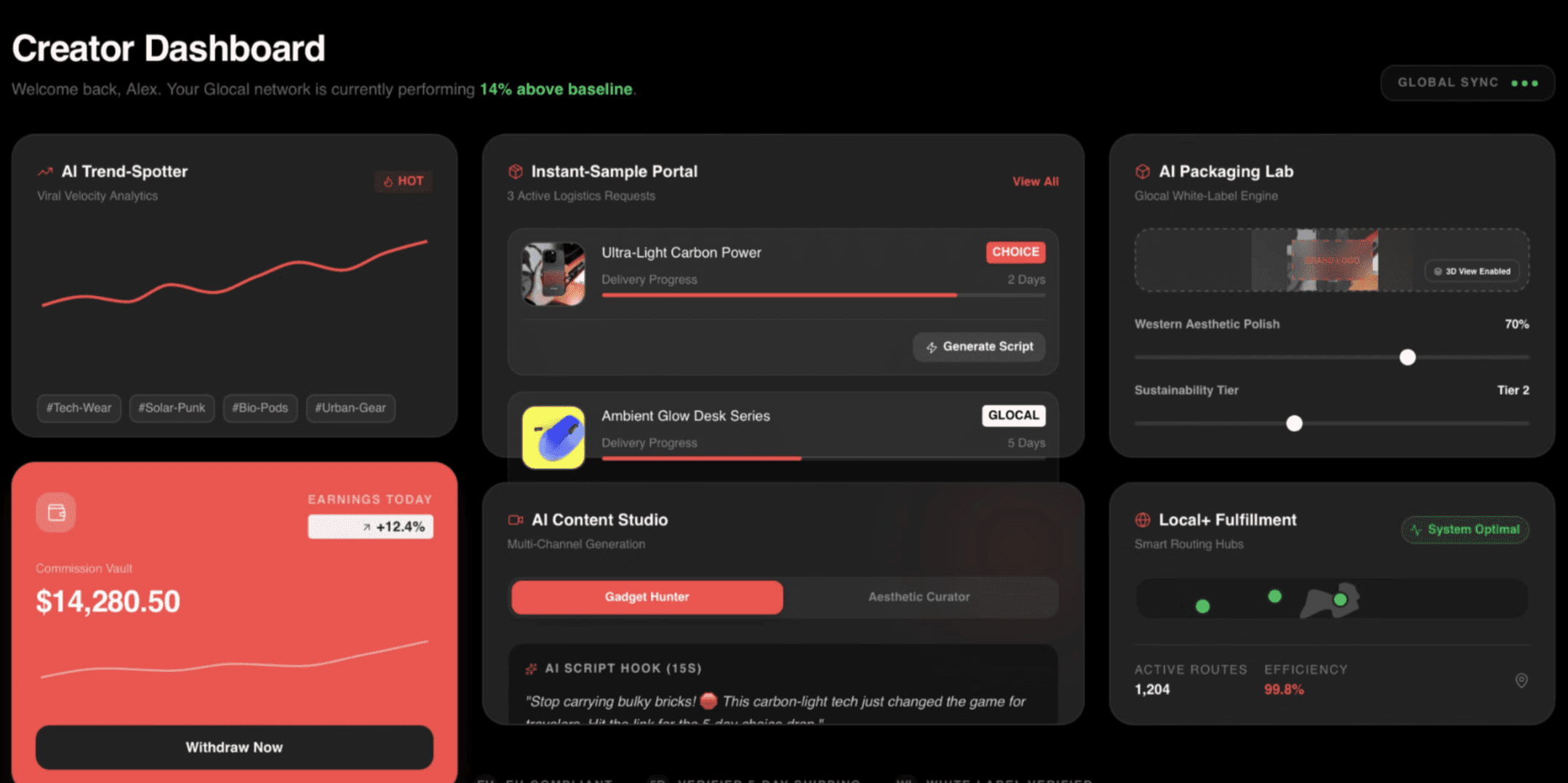
I used Gemini to generate three distinct product directions– a Creator-Flow Suite, a White-Label Accelerator, and the final "Bridge-to-West" Seller Portal– each representing a different stakeholder POV on the same problem.
My first attempt– vibe-coding the Creator-Flow Suite into Figma Make– failed entirely. Without defined user flows, the prompt was too abstract to act on. That failure was clarifying: I pivoted to the seller-perspective PRD and shifted to Google AI Studio, which produced a React shell I could actually iterate on.
The Critique Loop: Making AI Question Itself
From there, I introduced a back-and-forth procedure: screenshotting the Google AI Studio prototype, feeding it back to Gemini for a "Senior Architect" UX critique, then using those critiques to generate refined prompts for the next build. This reframed AI from a tool that executes into something closer to a design partner– one I had to actively push to be critical rather than just complimentary.

The Solution
AliExpress Global Brand Readiness Portal
A seller-side portal built on the idea that trust is something you can measure and then improve. Five tools move a manufacturer from an unknown listing to a creator partnership that actually closes.
Global Brand Readiness (GBR) Index
A dynamic credibility score– calculated across logistics reliability, cultural accuracy, and communication quality– displayed as a live "health bar" in the header. Sellers can drill into a "Calculation Logic" modal that explains exactly what's driving their score and surfaces a prioritized "Growth Blueprint" of next actions.

2. Cultural Match Engine
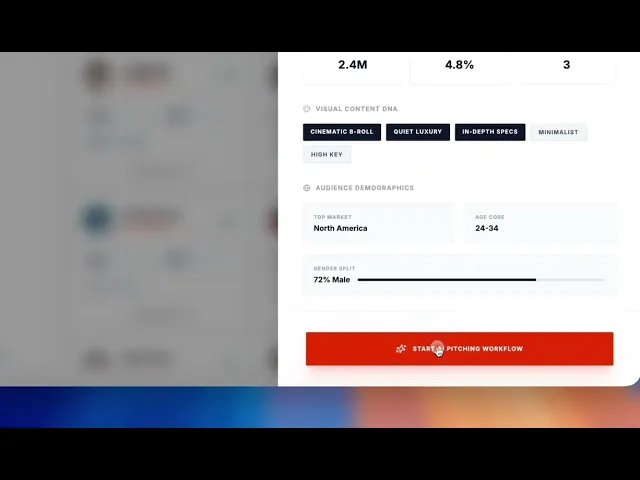
A searchable creator directory that surfaces influencers by Alignment Score and Category Affinity rather than follower count, with each card showing content style, audience demographics, and previously partnered brands, giving sellers the context to pitch the right person, not just the biggest one.
AI Outreach Transcoder
A dual-pane tool where sellers write their pitch in Chinese and receive a culturally adapted English version in real time — reregistering tone, removing high-pressure language, and producing a message that reads as relationship-first rather than transactional.

Collaboration Hub
A comprehensive dashboard tracking every active partnership from first pitch through content going live, with per-card messaging threads, estimated engagement, and contextual "Next Action" buttons, so sellers always know exactly what step comes next.

Payments & Escrow
A financial dashboard tracking revenue, creator payouts, and escrow releases against individual campaign milestones– with every transaction tied directly to a campaign ID, making it easy to trace which partnership drove which revenue event.

Reflection
Success Metrics
This project pushed me to fundamentally rethink how I work with AI, as I moved from using it as an executor that follows instructions to treating it as a design partner I had to actively interrogate. The most valuable shift was introducing a critique loop: feeding screenshots back to Gemini, asking it to evaluate its own output as a "Senior UX Architect," then using those critiques to drive the next iteration.
That back-and-forth produced decisions– like reframing "Western Trust Score" as "Global Brand Readiness Index"– that I wouldn't have reached by prompting in one direction alone. For future projects, I want to deliberately prompt AI to find alternative directions before committing to one, and cross-check outputs across different models rather than staying within a single ecosystem.
What I'd measure if this shipped:
Outreach Response Rate: Are more Western creators accepting pitches from Chinese sellers?
Time-to-Collaboration: How long from first pitch to sample sent?
GBR Index Improvement Over Time: Are sellers actually changing their behavior based on the score?


More Works


FAQ
01
What kind of work are you looking for?
02
What makes your approach different?
03
Do you research or just design?
04
How do you work with AI?
05
Why is some of this academic work?
06
Can you actually build, or only design?
07
What tools do you work in?
08
How do I reach you?
2026
Global Brand Readiness for AliExpress: Manufacturer Portal
An AI-powered seller portal that closes the trust gap between Chinese manufacturers and the Western influencers who move product.
Global Marketing
Technical Dashboard
Contributions
Role: Product Designer & UX Researcher (Individual Project)
Timeline: 4 weeks (January - February 2026)
Tools: Gemini (Research & Critique), Google AI Studio (Prototyping)
The Goal
Gain the Trust of Western Markets through Influencer Collaboration
The design aim is two-fold: lower the cognitive load for Chinese merchants trying to navigate shifting Western social commerce trends, and proactively de-risk brand partnerships for quality-conscious Western influencers.
Discovery
AI-Augmented Research
A primary goal of my design leadership was ensuring the interaction model was non-belittling. We implemented a three-tiered input strategy to ensure the user felt in control regardless of their environment.
Ecosystem Mapping
I sourced and aggregated quotes and stories from real users on forum posts, articles, about the Chinese e-commerce (Taobao, Tmall, JD.com) to understand native seller behaviors.
AI-Generated Personas
I used Gemini to synthesize eight evidence-based profiles, including the "Side-Hustle Visionary" in Texas and the "Red-Note Trend-Chaser" in China, to map the international usage of Alibaba’s ecosystem.
Influencer Archetypes
I generated key creator personas like the "Aesthetic Find Curator" and "Gadget Hunter" to understand what Western audiences value: speed, authenticity, and "vibe".
The Iterative Process
Taking AI from a Good Employee to a Design Partner
A primary goal of my design leadership was ensuring the interaction model was non-belittling. We implemented a three-tiered input strategy to ensure the user felt in control regardless of their environment.
Building the Foundation: PRDs & the Pivot
I used Gemini to generate three distinct product directions– a Creator-Flow Suite, a White-Label Accelerator, and the final "Bridge-to-West" Seller Portal– each representing a different stakeholder POV on the same problem.
My first attempt– vibe-coding the Creator-Flow Suite into Figma Make– failed entirely. Without defined user flows, the prompt was too abstract to act on. That failure was clarifying: I pivoted to the seller-perspective PRD and shifted to Google AI Studio, which produced a React shell I could actually iterate on.
The Critique Loop: Making AI Question Itself
From there, I introduced a back-and-forth procedure: screenshotting the Google AI Studio prototype, feeding it back to Gemini for a "Senior Architect" UX critique, then using those critiques to generate refined prompts for the next build. This reframed AI from a tool that executes into something closer to a design partner– one I had to actively push to be critical rather than just complimentary.
The Solution
AliExpress Global Brand Readiness Portal
A seller-side portal built on the idea that trust is something you can measure and then improve. Five tools move a manufacturer from an unknown listing to a creator partnership that actually closes.
Global Brand Readiness (GBR) Index
A dynamic credibility score– calculated across logistics reliability, cultural accuracy, and communication quality– displayed as a live "health bar" in the header. Sellers can drill into a "Calculation Logic" modal that explains exactly what's driving their score and surfaces a prioritized "Growth Blueprint" of next actions.
2. Cultural Match Engine
A searchable creator directory that surfaces influencers by Alignment Score and Category Affinity rather than follower count, with each card showing content style, audience demographics, and previously partnered brands, giving sellers the context to pitch the right person, not just the biggest one.
AI Outreach Transcoder
A dual-pane tool where sellers write their pitch in Chinese and receive a culturally adapted English version in real time — reregistering tone, removing high-pressure language, and producing a message that reads as relationship-first rather than transactional.
Collaboration Hub
A comprehensive dashboard tracking every active partnership from first pitch through content going live, with per-card messaging threads, estimated engagement, and contextual "Next Action" buttons, so sellers always know exactly what step comes next.
Payments & Escrow
A financial dashboard tracking revenue, creator payouts, and escrow releases against individual campaign milestones– with every transaction tied directly to a campaign ID, making it easy to trace which partnership drove which revenue event.
Reflection
Success Metrics
This project pushed me to fundamentally rethink how I work with AI, as I moved from using it as an executor that follows instructions to treating it as a design partner I had to actively interrogate. The most valuable shift was introducing a critique loop: feeding screenshots back to Gemini, asking it to evaluate its own output as a "Senior UX Architect," then using those critiques to drive the next iteration.
That back-and-forth produced decisions– like reframing "Western Trust Score" as "Global Brand Readiness Index"– that I wouldn't have reached by prompting in one direction alone. For future projects, I want to deliberately prompt AI to find alternative directions before committing to one, and cross-check outputs across different models rather than staying within a single ecosystem.
What I'd measure if this shipped:
Outreach Response Rate: Are more Western creators accepting pitches from Chinese sellers?
Time-to-Collaboration: How long from first pitch to sample sent?
GBR Index Improvement Over Time: Are sellers actually changing their behavior based on the score?
More Works
FAQ
01
What kind of work are you looking for?
02
What makes your approach different?
03
Do you research or just design?
04
How do you work with AI?
05
Why is some of this academic work?
06
Can you actually build, or only design?
07
What tools do you work in?
08
How do I reach you?
2026
Global Brand Readiness for AliExpress: Manufacturer Portal
An AI-powered seller portal that closes the trust gap between Chinese manufacturers and the Western influencers who move product.
Global Marketing
Technical Dashboard
Contributions
Role: Product Designer & UX Researcher (Individual Project)
Timeline: 4 weeks (January - February 2026)
Tools: Gemini (Research & Critique), Google AI Studio (Prototyping)
The Goal
Gain the Trust of Western Markets through Influencer Collaboration
The design aim is two-fold: lower the cognitive load for Chinese merchants trying to navigate shifting Western social commerce trends, and proactively de-risk brand partnerships for quality-conscious Western influencers.
Discovery
AI-Augmented Research
A primary goal of my design leadership was ensuring the interaction model was non-belittling. We implemented a three-tiered input strategy to ensure the user felt in control regardless of their environment.
Ecosystem Mapping
I sourced and aggregated quotes and stories from real users on forum posts, articles, about the Chinese e-commerce (Taobao, Tmall, JD.com) to understand native seller behaviors.
AI-Generated Personas
I used Gemini to synthesize eight evidence-based profiles, including the "Side-Hustle Visionary" in Texas and the "Red-Note Trend-Chaser" in China, to map the international usage of Alibaba’s ecosystem.
Influencer Archetypes
I generated key creator personas like the "Aesthetic Find Curator" and "Gadget Hunter" to understand what Western audiences value: speed, authenticity, and "vibe".
The Iterative Process
Taking AI from a Good Employee to a Design Partner
A primary goal of my design leadership was ensuring the interaction model was non-belittling. We implemented a three-tiered input strategy to ensure the user felt in control regardless of their environment.
Building the Foundation: PRDs & the Pivot
I used Gemini to generate three distinct product directions– a Creator-Flow Suite, a White-Label Accelerator, and the final "Bridge-to-West" Seller Portal– each representing a different stakeholder POV on the same problem.
My first attempt– vibe-coding the Creator-Flow Suite into Figma Make– failed entirely. Without defined user flows, the prompt was too abstract to act on. That failure was clarifying: I pivoted to the seller-perspective PRD and shifted to Google AI Studio, which produced a React shell I could actually iterate on.
The Critique Loop: Making AI Question Itself
From there, I introduced a back-and-forth procedure: screenshotting the Google AI Studio prototype, feeding it back to Gemini for a "Senior Architect" UX critique, then using those critiques to generate refined prompts for the next build. This reframed AI from a tool that executes into something closer to a design partner– one I had to actively push to be critical rather than just complimentary.
The Solution
AliExpress Global Brand Readiness Portal
A seller-side portal built on the idea that trust is something you can measure and then improve. Five tools move a manufacturer from an unknown listing to a creator partnership that actually closes.
Global Brand Readiness (GBR) Index
A dynamic credibility score– calculated across logistics reliability, cultural accuracy, and communication quality– displayed as a live "health bar" in the header. Sellers can drill into a "Calculation Logic" modal that explains exactly what's driving their score and surfaces a prioritized "Growth Blueprint" of next actions.
2. Cultural Match Engine
A searchable creator directory that surfaces influencers by Alignment Score and Category Affinity rather than follower count, with each card showing content style, audience demographics, and previously partnered brands, giving sellers the context to pitch the right person, not just the biggest one.
AI Outreach Transcoder
A dual-pane tool where sellers write their pitch in Chinese and receive a culturally adapted English version in real time — reregistering tone, removing high-pressure language, and producing a message that reads as relationship-first rather than transactional.
Collaboration Hub
A comprehensive dashboard tracking every active partnership from first pitch through content going live, with per-card messaging threads, estimated engagement, and contextual "Next Action" buttons, so sellers always know exactly what step comes next.
Payments & Escrow
A financial dashboard tracking revenue, creator payouts, and escrow releases against individual campaign milestones– with every transaction tied directly to a campaign ID, making it easy to trace which partnership drove which revenue event.
Reflection
Success Metrics
This project pushed me to fundamentally rethink how I work with AI, as I moved from using it as an executor that follows instructions to treating it as a design partner I had to actively interrogate. The most valuable shift was introducing a critique loop: feeding screenshots back to Gemini, asking it to evaluate its own output as a "Senior UX Architect," then using those critiques to drive the next iteration.
That back-and-forth produced decisions– like reframing "Western Trust Score" as "Global Brand Readiness Index"– that I wouldn't have reached by prompting in one direction alone. For future projects, I want to deliberately prompt AI to find alternative directions before committing to one, and cross-check outputs across different models rather than staying within a single ecosystem.
What I'd measure if this shipped:
Outreach Response Rate: Are more Western creators accepting pitches from Chinese sellers?
Time-to-Collaboration: How long from first pitch to sample sent?
GBR Index Improvement Over Time: Are sellers actually changing their behavior based on the score?
More Works
FAQ
What kind of work are you looking for?
What makes your approach different?
Do you research or just design?
How do you work with AI?
Why is some of this academic work?
Can you actually build, or only design?
What tools do you work in?
How do I reach you?