
2026
Polyglot.UI: Multi-Agent AI for Cross-Cultural Evaluation
A multi-agent framework for cultural alignment in advertising. Audits designs for deep localization, using grounded specialist agents to flag cultural, structural, and semiotic risks for teams scaling products across global markets
Cultural Aligment
Multi-Agent Analysis
Contributions
Role: Sole Designer and Builder (Independent Project)
Timeline: April 2026 ~2 Weeks
Stack: Claude API, Cursor, Next.js, Vercel
Contributions
Role: Sole Designer and Builder (Independent Project)
Timeline: April 2026 ~2 Weeks
Stack: Claude API, Cursor, Next.js, Vercel
The Approach
A "Council of Four" Specialists Take On Cross-Cultural Evaluation
I didn't want another translation tool. I wanted something that reasons about a design the way a panel of specialists would– so I built a "Council of Four": four AI agents, each grounded in a specific, authoritative dataset so it stays in its lane, plus a fifth orchestrator that resolves their disagreements into a single verdict.
The Problem
Translation Isn't Localization
Companies assume that swapping English text for Chinese or Arabic makes a product "localized." It doesn't. Translation handles words; it ignores the cognitive, physical, and semiotic expectations that actually determine whether a design works in a market. I broke the problem into three failures a translation layer can't see:
The Problem
Translation Isn't Localization
Companies assume that swapping English text for Chinese or Arabic makes a product "localized." It doesn't. Translation handles words; it ignores the cognitive, physical, and semiotic expectations that actually determine whether a design works in a market. I broke the problem into three failures a translation layer can't see:
The Cognitive Gap
A minimalist Western layout can read as "empty" or untrustworthy to a high-context user in China, while a dense Eastern layout can feel "cluttered" to a Scandinavian user. The information density itself has to match the user's mental model of good design.
The Physics of Language
Languages have different physical properties. German expands by up to 30%, Arabic flows right-to-left and mirrors the entire layout. Designers build pixel-perfect English mockups that collide the moment real localized text lands in them.
The Semiotic Blind Spot
Color and iconography aren't universal. Red signals danger in the US but luck in China. A thumbs-up is approval in the West and an insult in parts of the Middle East. A single default choice can quietly alienate an entire market.
The Approach
An Expert Panel, Not a Spell-Checker
I didn't want another translation tool. I wanted something that reasons about a design the way a panel of specialists would– so I built a "Council of Four": four AI agents, each grounded in a specific, authoritative dataset so it stays in its lane, plus a fifth orchestrator that resolves their disagreements into a single verdict.
The Approach
An Expert Panel, Not a Spell-Checker
I didn't want another translation tool. I wanted something that reasons about a design the way a panel of specialists would– so I built a "Council of Four": four AI agents, each grounded in a specific, authoritative dataset so it stays in its lane, plus a fifth orchestrator that resolves their disagreements into a single verdict.
Culture Analyst
Grounded in Hofstede's Cultural Dimensions.
Reads UI tone and hierarchy against power distance and uncertainty avoidance. (Should this interface feel authoritative? Does it need more reassurance and documentation?)

Layout Specialist
Grounded in Unicode CLDR.
Audits text-expansion risk, currency/date formatting, and the localization "physics" that break containers.

Flow & Direction Expert
Grounded in W3C i18n standards
Checks script direction (RTL/LTR), layout mirroring, vertical rhythm, and responsive breakpoints across markets.

Symbols & Color Analyst
Grounded in the World Color Survey and semiotic research.
Flags color meanings and icon metaphors that carry risk in the target culture.

The Orchestrator
A fifth "master designer" agent that takes the conflicting findings (the Culture Analyst wants more density; the Layout Specialist warns the text is already overflowing) and synthesizes them into one cohesive report and score.

Add image
Add image
Hand Controls
Standard hand gestures can help users navigate WayBack's routing system. Pinching index and thumb for "YES," middle finger and thumb for "NO," index finger run over thumb to scroll.
Glasses Overview
Using the Neural Band, people can identify intuitive hand gestures for easier travelling through busy urban spaces.
Core Features
What the Tool Gives Back
Run a screenshot through Polyglot and two things come back: a map of exactly where the risks live, and a single score that says whether the design is ready to ship.
Core Features
What the Tool Gives Back
Run a screenshot through Polyglot and two things come back: a map of exactly where the risks live, and a single score that says whether the design is ready to ship.


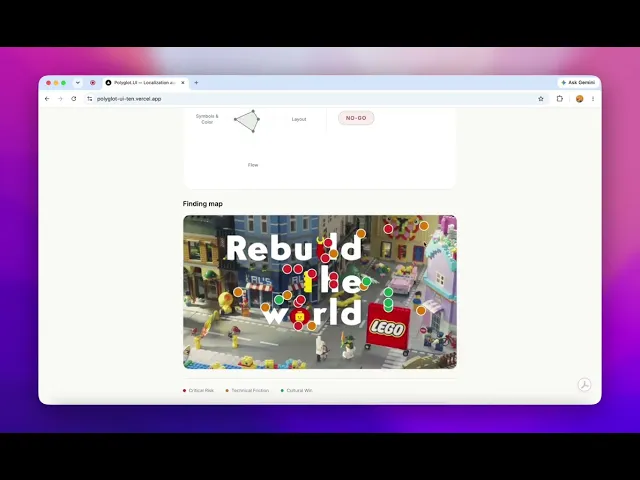
Spatial Pin Overlay
The original screenshot comes back with colored pins dropped directly on the problem areas– red for high cultural risk, yellow for technical friction, green for a cultural win– so you see exactly where an issue lives.
Global Readiness Score
A radar chart scoring the design across four axes–Culture, Physics, Semiotics, Logic– for an instant go / caution / no-go read on a target market.
How it Works
Behind the Scenes
There are no separate "bots." Each agent is the same Claude model invoked with a different system prompt– one call per specialist, run in parallel, then a final orchestrator call that reads all four opinions and produces the consensus.
How it Works
Behind the Scenes
There are no separate "bots." Each agent is the same Claude model invoked with a different system prompt– one call per specialist, run in parallel, then a final orchestrator call that reads all four opinions and produces the consensus.

The Build
Learning the Infrastructure by Needing It
Building Polyglot.UI forced me to experiment with AI and expand my perception of how it can be used in design.
The Build
Learning the Infrastructure by Needing It
Building Polyglot.UI forced me to experiment with AI and expand my perception of how it can be used in design.

Ideation with AI, and its trap
I started by using Gemini to pressure-test the concept against existing tools (Lokalise, Crowdin) so I wasn't rebuilding translation software. The most useful lesson came from a failure mode: when I asked the AI whether an idea was good, it just agreed with whatever I proposed. Treating it as an oracle produced confirmation bias; treating it as a brainstorm partner– "give me five directions, then I'll choose"– produced the breakthrough, including the multi-agent framing itself.
A detour through n8n
I first tried to build the council visually in n8n. I worked through tutorials, used Claude as a teacher to decode error states, and got a workflow that almost ran before I hit the wall: I could barely reason through why it was wired the way it was, and I couldn't fix it. I ran out of credits and walked away– with a clear takeaway I now design by: don't ship what you can't reason about.

How It Works
The Real Mechanisms, Behind the Curtain
After trying— and failing— to build Polyglot.UI with the n8n framework, I stepped back and re-approached the problem. Luckily, during my detour with n8n I had actually built most of what I needed to run Polyglot.UI more simply with Claude.
How It Works
The Real Mechanisms, Behind the Curtain
After trying— and failing— to build Polyglot.UI with the n8n framework, I stepped back and re-approached the problem. Luckily, during my detour with n8n I had actually built most of what I needed to run Polyglot.UI more simply with Claude.
Building It for Real
A minimalist Western layout can read as "empty" or untrustworthy to a high-context user in China, while a dense Eastern layout can feel "cluttered" to a Scandinavian user. The information density itself has to match the user's mental model of good design.
Designing the Inputs
Earlier in the process I'd built the supporting design artifacts the way I do on every project– a need statement (rewritten to the NN/g framework), personas, and an AI-oriented PRD– so the build had a real spec behind it rather than a vibe.
Reflection
AI: From Executor to Adversary
The biggest shift in this project was in how I work with AI. I moved from using it as an executor that follows instructions to treating it as something I have to actively interrogate, because a model that always agrees with you will happily walk you down the wrong path.
A few principles I now build into my AI workflows:
Force divergence. Ask for three to five distinct directions, including one that argues the opposite, before committing to any.
Make the model contradict itself. Staging two positions against each other surfaces my own judgment instead of outsourcing it.
Ground everything. The "zero hallucinated locale data" rule– pinning each agent to a named source– is what separates a credible audit from a confident guess.
Looking Forward
Measuring Success
The open question Polyglot.UI left me with is the one I most want to work on next: these agents make judgments about culture and correctness, but how do you know a judgment is right? The natural next step is validating the agents' findings against expert-labeled ground truth, turning a persuasive prototype into something measurably reliable.
Collision detection accuracy: How reliably it predicts text-expansion and layout breaks for a target language.
Audit speed: Time from a single screenshot to a complete, scored report.
Designer adoption: How many of the tool's "green pin" recommendations actually make it into the final design.


More Works

FAQ
01
What kind of work are you looking for?
02
What makes your approach different?
03
Do you research or just design?
04
How do you work with AI?
05
Why is some of this academic work?
06
Can you actually build, or only design?
07
What tools do you work in?
08
How do I reach you?
2026
Polyglot.UI: Multi-Agent AI for Cross-Cultural Evaluation
A multi-agent framework for cultural alignment in advertising. Audits designs for deep localization, using grounded specialist agents to flag cultural, structural, and semiotic risks for teams scaling products across global markets
Cultural Aligment
Multi-Agent Analysis
Contributions
Role: Sole Designer and Builder (Independent Project)
Timeline: April 2026 ~2 Weeks
Stack: Claude API, Cursor, Next.js, Vercel
The Approach
A "Council of Four" Specialists Take On Cross-Cultural Evaluation
I didn't want another translation tool. I wanted something that reasons about a design the way a panel of specialists would– so I built a "Council of Four": four AI agents, each grounded in a specific, authoritative dataset so it stays in its lane, plus a fifth orchestrator that resolves their disagreements into a single verdict.
The Problem
Translation Isn't Localization
Companies assume that swapping English text for Chinese or Arabic makes a product "localized." It doesn't. Translation handles words; it ignores the cognitive, physical, and semiotic expectations that actually determine whether a design works in a market. I broke the problem into three failures a translation layer can't see:
The Cognitive Gap
A minimalist Western layout can read as "empty" or untrustworthy to a high-context user in China, while a dense Eastern layout can feel "cluttered" to a Scandinavian user. The information density itself has to match the user's mental model of good design.
The Physics of Language
Languages have different physical properties. German expands by up to 30%, Arabic flows right-to-left and mirrors the entire layout. Designers build pixel-perfect English mockups that collide the moment real localized text lands in them.
The Semiotic Blind Spot
Color and iconography aren't universal. Red signals danger in the US but luck in China. A thumbs-up is approval in the West and an insult in parts of the Middle East. A single default choice can quietly alienate an entire market.
The Approach
An Expert Panel, Not a Spell-Checker
I didn't want another translation tool. I wanted something that reasons about a design the way a panel of specialists would– so I built a "Council of Four": four AI agents, each grounded in a specific, authoritative dataset so it stays in its lane, plus a fifth orchestrator that resolves their disagreements into a single verdict.
The Approach
An Expert Panel, Not a Spell-Checker
I didn't want another translation tool. I wanted something that reasons about a design the way a panel of specialists would– so I built a "Council of Four": four AI agents, each grounded in a specific, authoritative dataset so it stays in its lane, plus a fifth orchestrator that resolves their disagreements into a single verdict.
Culture Analyst
Grounded in Hofstede's Cultural Dimensions.
Reads UI tone and hierarchy against power distance and uncertainty avoidance. (Should this interface feel authoritative? Does it need more reassurance and documentation?)
Layout Specialist
Grounded in Unicode CLDR.
Audits text-expansion risk, currency/date formatting, and the localization "physics" that break containers.
Flow & Direction Expert
Grounded in W3C i18n standards
Checks script direction (RTL/LTR), layout mirroring, vertical rhythm, and responsive breakpoints across markets.
Symbols & Color Analyst
Grounded in the World Color Survey and semiotic research.
Flags color meanings and icon metaphors that carry risk in the target culture.
The Orchestrator
A fifth "master designer" agent that takes the conflicting findings (the Culture Analyst wants more density; the Layout Specialist warns the text is already overflowing) and synthesizes them into one cohesive report and score.
Add image
Add image
Hand Controls
Standard hand gestures can help users navigate WayBack's routing system. Pinching index and thumb for "YES," middle finger and thumb for "NO," index finger run over thumb to scroll.
Glasses Overview
Using the Neural Band, people can identify intuitive hand gestures for easier travelling through busy urban spaces.
Core Features
What the Tool Gives Back
Run a screenshot through Polyglot and two things come back: a map of exactly where the risks live, and a single score that says whether the design is ready to ship.
Spatial Pin Overlay
The original screenshot comes back with colored pins dropped directly on the problem areas– red for high cultural risk, yellow for technical friction, green for a cultural win– so you see exactly where an issue lives.
Global Readiness Score
A radar chart scoring the design across four axes–Culture, Physics, Semiotics, Logic– for an instant go / caution / no-go read on a target market.
How it Works
Behind the Scenes
There are no separate "bots." Each agent is the same Claude model invoked with a different system prompt– one call per specialist, run in parallel, then a final orchestrator call that reads all four opinions and produces the consensus.
The Build
Learning the Infrastructure by Needing It
Building Polyglot.UI forced me to experiment with AI and expand my perception of how it can be used in design.
Ideation with AI, and its trap
I started by using Gemini to pressure-test the concept against existing tools (Lokalise, Crowdin) so I wasn't rebuilding translation software. The most useful lesson came from a failure mode: when I asked the AI whether an idea was good, it just agreed with whatever I proposed. Treating it as an oracle produced confirmation bias; treating it as a brainstorm partner– "give me five directions, then I'll choose"– produced the breakthrough, including the multi-agent framing itself.
A detour through n8n
I first tried to build the council visually in n8n. I worked through tutorials, used Claude as a teacher to decode error states, and got a workflow that almost ran before I hit the wall: I could barely reason through why it was wired the way it was, and I couldn't fix it. I ran out of credits and walked away– with a clear takeaway I now design by: don't ship what you can't reason about.
How It Works
The Real Mechanisms, Behind the Curtain
After trying— and failing— to build Polyglot.UI with the n8n framework, I stepped back and re-approached the problem. Luckily, during my detour with n8n I had actually built most of what I needed to run Polyglot.UI more simply with Claude.
Building It for Real
A minimalist Western layout can read as "empty" or untrustworthy to a high-context user in China, while a dense Eastern layout can feel "cluttered" to a Scandinavian user. The information density itself has to match the user's mental model of good design.
Designing the Inputs
Earlier in the process I'd built the supporting design artifacts the way I do on every project– a need statement (rewritten to the NN/g framework), personas, and an AI-oriented PRD– so the build had a real spec behind it rather than a vibe.
Reflection
AI: From Executor to Adversary
The biggest shift in this project was in how I work with AI. I moved from using it as an executor that follows instructions to treating it as something I have to actively interrogate, because a model that always agrees with you will happily walk you down the wrong path.
A few principles I now build into my AI workflows:
Force divergence. Ask for three to five distinct directions, including one that argues the opposite, before committing to any.
Make the model contradict itself. Staging two positions against each other surfaces my own judgment instead of outsourcing it.
Ground everything. The "zero hallucinated locale data" rule– pinning each agent to a named source– is what separates a credible audit from a confident guess.
Looking Forward
Measuring Success
The open question Polyglot.UI left me with is the one I most want to work on next: these agents make judgments about culture and correctness, but how do you know a judgment is right? The natural next step is validating the agents' findings against expert-labeled ground truth, turning a persuasive prototype into something measurably reliable.
Collision detection accuracy: How reliably it predicts text-expansion and layout breaks for a target language.
Audit speed: Time from a single screenshot to a complete, scored report.
Designer adoption: How many of the tool's "green pin" recommendations actually make it into the final design.
More Works
FAQ
01
What kind of work are you looking for?
02
What makes your approach different?
03
Do you research or just design?
04
How do you work with AI?
05
Why is some of this academic work?
06
Can you actually build, or only design?
07
What tools do you work in?
08
How do I reach you?
2026
Polyglot.UI: Multi-Agent AI for Cross-Cultural Evaluation
A multi-agent framework for cultural alignment in advertising. Audits designs for deep localization, using grounded specialist agents to flag cultural, structural, and semiotic risks for teams scaling products across global markets
Cultural Aligment
Multi-Agent Analysis
Contributions
Role: Sole Designer and Builder (Independent Project)
Timeline: April 2026 ~2 Weeks
Stack: Claude API, Cursor, Next.js, Vercel
The Approach
A "Council of Four" Specialists Take On Cross-Cultural Evaluation
I didn't want another translation tool. I wanted something that reasons about a design the way a panel of specialists would– so I built a "Council of Four": four AI agents, each grounded in a specific, authoritative dataset so it stays in its lane, plus a fifth orchestrator that resolves their disagreements into a single verdict.
The Problem
Translation Isn't Localization
Companies assume that swapping English text for Chinese or Arabic makes a product "localized." It doesn't. Translation handles words; it ignores the cognitive, physical, and semiotic expectations that actually determine whether a design works in a market. I broke the problem into three failures a translation layer can't see:
The Cognitive Gap
A minimalist Western layout can read as "empty" or untrustworthy to a high-context user in China, while a dense Eastern layout can feel "cluttered" to a Scandinavian user. The information density itself has to match the user's mental model of good design.
The Physics of Language
Languages have different physical properties. German expands by up to 30%, Arabic flows right-to-left and mirrors the entire layout. Designers build pixel-perfect English mockups that collide the moment real localized text lands in them.
The Semiotic Blind Spot
Color and iconography aren't universal. Red signals danger in the US but luck in China. A thumbs-up is approval in the West and an insult in parts of the Middle East. A single default choice can quietly alienate an entire market.
The Approach
An Expert Panel, Not a Spell-Checker
I didn't want another translation tool. I wanted something that reasons about a design the way a panel of specialists would– so I built a "Council of Four": four AI agents, each grounded in a specific, authoritative dataset so it stays in its lane, plus a fifth orchestrator that resolves their disagreements into a single verdict.
The Approach
An Expert Panel, Not a Spell-Checker
I didn't want another translation tool. I wanted something that reasons about a design the way a panel of specialists would– so I built a "Council of Four": four AI agents, each grounded in a specific, authoritative dataset so it stays in its lane, plus a fifth orchestrator that resolves their disagreements into a single verdict.
Culture Analyst
Grounded in Hofstede's Cultural Dimensions.
Reads UI tone and hierarchy against power distance and uncertainty avoidance. (Should this interface feel authoritative? Does it need more reassurance and documentation?)
Layout Specialist
Grounded in Unicode CLDR.
Audits text-expansion risk, currency/date formatting, and the localization "physics" that break containers.
Flow & Direction Expert
Grounded in W3C i18n standards
Checks script direction (RTL/LTR), layout mirroring, vertical rhythm, and responsive breakpoints across markets.
Symbols & Color Analyst
Grounded in the World Color Survey and semiotic research.
Flags color meanings and icon metaphors that carry risk in the target culture.
The Orchestrator
A fifth "master designer" agent that takes the conflicting findings (the Culture Analyst wants more density; the Layout Specialist warns the text is already overflowing) and synthesizes them into one cohesive report and score.
Add image
Add image
Hand Controls
Standard hand gestures can help users navigate WayBack's routing system. Pinching index and thumb for "YES," middle finger and thumb for "NO," index finger run over thumb to scroll.
Glasses Overview
Using the Neural Band, people can identify intuitive hand gestures for easier travelling through busy urban spaces.
Core Features
What the Tool Gives Back
Run a screenshot through Polyglot and two things come back: a map of exactly where the risks live, and a single score that says whether the design is ready to ship.
Spatial Pin Overlay
The original screenshot comes back with colored pins dropped directly on the problem areas– red for high cultural risk, yellow for technical friction, green for a cultural win– so you see exactly where an issue lives.
Global Readiness Score
A radar chart scoring the design across four axes–Culture, Physics, Semiotics, Logic– for an instant go / caution / no-go read on a target market.
How it Works
Behind the Scenes
There are no separate "bots." Each agent is the same Claude model invoked with a different system prompt– one call per specialist, run in parallel, then a final orchestrator call that reads all four opinions and produces the consensus.
The Build
Learning the Infrastructure by Needing It
Building Polyglot.UI forced me to experiment with AI and expand my perception of how it can be used in design.
Ideation with AI, and its trap
I started by using Gemini to pressure-test the concept against existing tools (Lokalise, Crowdin) so I wasn't rebuilding translation software. The most useful lesson came from a failure mode: when I asked the AI whether an idea was good, it just agreed with whatever I proposed. Treating it as an oracle produced confirmation bias; treating it as a brainstorm partner– "give me five directions, then I'll choose"– produced the breakthrough, including the multi-agent framing itself.
A detour through n8n
I first tried to build the council visually in n8n. I worked through tutorials, used Claude as a teacher to decode error states, and got a workflow that almost ran before I hit the wall: I could barely reason through why it was wired the way it was, and I couldn't fix it. I ran out of credits and walked away– with a clear takeaway I now design by: don't ship what you can't reason about.
How It Works
The Real Mechanisms, Behind the Curtain
After trying— and failing— to build Polyglot.UI with the n8n framework, I stepped back and re-approached the problem. Luckily, during my detour with n8n I had actually built most of what I needed to run Polyglot.UI more simply with Claude.
Building It for Real
A minimalist Western layout can read as "empty" or untrustworthy to a high-context user in China, while a dense Eastern layout can feel "cluttered" to a Scandinavian user. The information density itself has to match the user's mental model of good design.
Designing the Inputs
Earlier in the process I'd built the supporting design artifacts the way I do on every project– a need statement (rewritten to the NN/g framework), personas, and an AI-oriented PRD– so the build had a real spec behind it rather than a vibe.
Reflection
AI: From Executor to Adversary
The biggest shift in this project was in how I work with AI. I moved from using it as an executor that follows instructions to treating it as something I have to actively interrogate, because a model that always agrees with you will happily walk you down the wrong path.
A few principles I now build into my AI workflows:
Force divergence. Ask for three to five distinct directions, including one that argues the opposite, before committing to any.
Make the model contradict itself. Staging two positions against each other surfaces my own judgment instead of outsourcing it.
Ground everything. The "zero hallucinated locale data" rule– pinning each agent to a named source– is what separates a credible audit from a confident guess.
Looking Forward
Measuring Success
The open question Polyglot.UI left me with is the one I most want to work on next: these agents make judgments about culture and correctness, but how do you know a judgment is right? The natural next step is validating the agents' findings against expert-labeled ground truth, turning a persuasive prototype into something measurably reliable.
Collision detection accuracy: How reliably it predicts text-expansion and layout breaks for a target language.
Audit speed: Time from a single screenshot to a complete, scored report.
Designer adoption: How many of the tool's "green pin" recommendations actually make it into the final design.
More Works
FAQ
What kind of work are you looking for?
What makes your approach different?
Do you research or just design?
How do you work with AI?
Why is some of this academic work?
Can you actually build, or only design?
What tools do you work in?
How do I reach you?