
2025
In Memoriam: Cognitive Persuasive Design
Using persuasive design to address digital overconsumption through a web-based experience. Challenging user perceptions of data tracking and targeted advertising.
Persuasive Design
Interactive Experience
Contributions
Role: Project Manager & Cognitive Research Lead
Team: Cameron Thompson, Camille Bove, Priyal Shrivastava, Uma Dhamija.
Timeline: 4 weeks (January - February 2026)
Tools: Figma, Figma Make
Contributions
Role: Project Manager & Cognitive Research Lead
Team: Cameron Thompson, Camille Bove, Priyal Shrivastava, Uma Dhamija.
Timeline: 4 weeks (January - February 2026)
Tools: Figma, Figma Make
Live Demo
Explore the Trend Obituary for Yourself
Click the button below!
Live Demo
Explore the Trend Obituary for Yourself
Click the button below!

Persuasive Design
Explicit Persuasion Often Backfires
To build a truly persuasive tool, I directed the integration of five core psychological frameworks to move the project from explicit intervention to a subtle, "embedded" design.
Persuasive Design
Explicit Persuasion Often Backfires
To build a truly persuasive tool, I directed the integration of five core psychological frameworks to move the project from explicit intervention to a subtle, "embedded" design.
Obfuscation
Obfuscation
Concealing the persuasive intent behind wit and entertainment to maintain engagement and bypass resistance.
Social Proof
Social Proof
Positioning "privacy awareness" as a new, desirable peer standard while revealing how algorithms use social proof to manipulate purchasing.
Social Identity Theory
Social Identity Theory
Encouraging users to dissociate from the "impulse buyer" group and adopt a more positive identity as an "aware consumer".
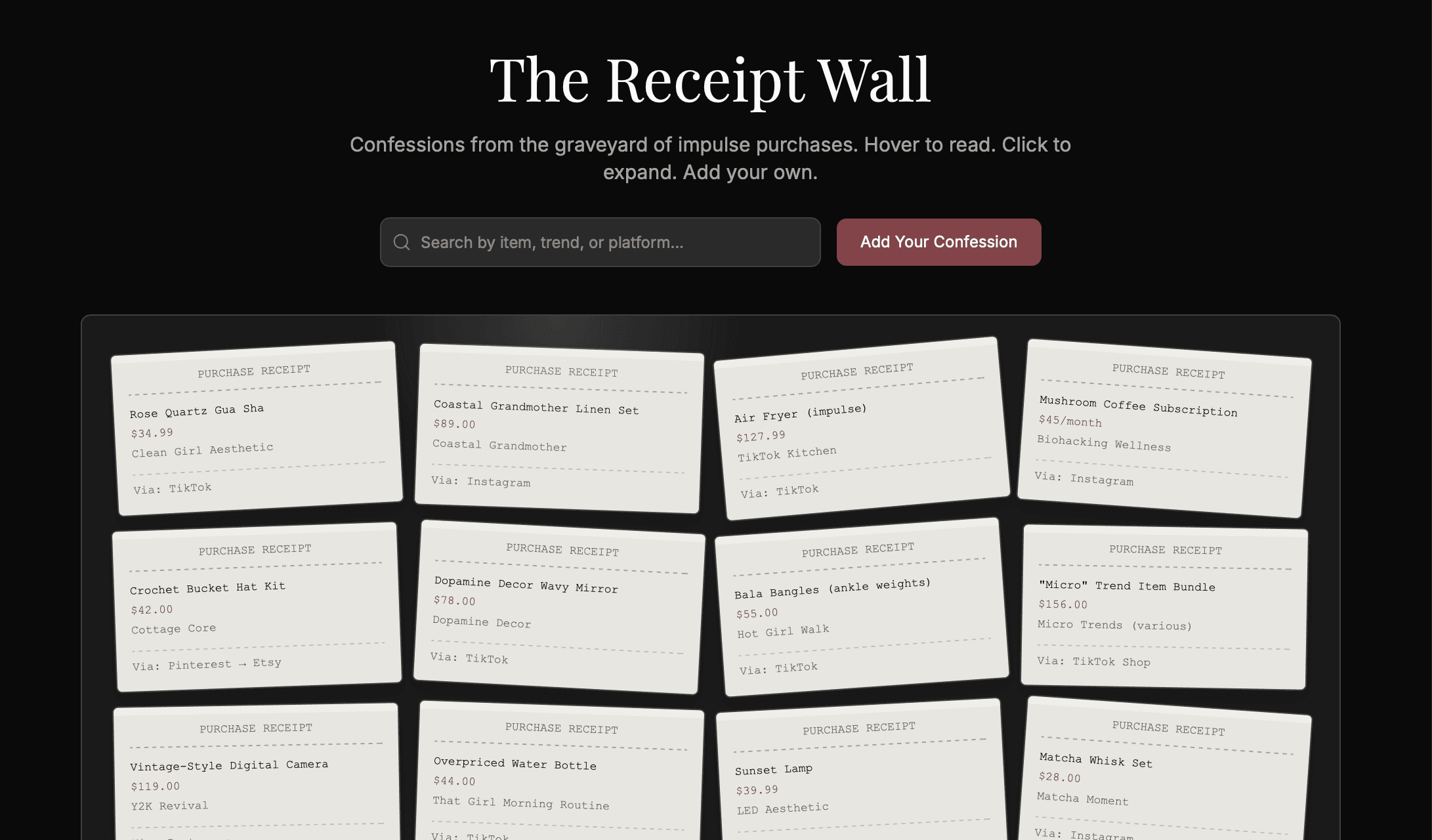
Using the "Receipt Wall" as a digital mirror to highlight discrepancies between a user's ideal standards and their actual consumption habits.
Elaboration Likelihood Method
Elaboration Likelihood Method
Meeting users in System 1 (fast, automatic) with high-impact visuals before gradually transitioning to System 2 (slow, deliberate) reflection.
The Pivot
Issues with Data Personalization
A primary goal of my design leadership was ensuring the interaction model was non-belittling. We implemented a three-tiered input strategy to ensure the user felt in control regardless of their environment.
The Pivot
Issues with Data Personalization
A primary goal of my design leadership was ensuring the interaction model was non-belittling. We implemented a three-tiered input strategy to ensure the user felt in control regardless of their environment.


The Discovery
Our project originally centered on "Data Dolls"—personalized avatars dressed in items users were actually being targeted with via ads.
However, testing revealed that seeing their own inferred data didn't lead users to become more cognizant of their data privacy settings.
Instead, users found the dolls "cool," becoming more interested in the products. Alternatively, some users felt shamed.
The Strategic Shift
The "Data Dolls" triggered Psychological Reactance, where the perceived attempt to change attitudes caused users to put up psychological barriers.
We realized that distancing the user from their own data was actually more effective. We pivoted to a non-personalized, socially-grounded concept that reduced feelings of individual shame by framing trend-driven consumption as a shared cultural experience.
The Solution
A Narrative Journey
The "In Memoriam" experience turns familiar trend-chasing into a chance to pause, laugh, and reflect through a specific narrative arc.
The Solution
A Narrative Journey
The "In Memoriam" experience turns familiar trend-chasing into a chance to pause, laugh, and reflect through a specific narrative arc.
The Trend Obituaries
We visualized the lifecycle of "dead" trends (e.g., Cottagecore) with "Death Graphs," pairing humorous epitaphs with data on financial and cultural impact. This turned abstract hype cycles into visible patterns users could recognize.

The Psychology Autopsy
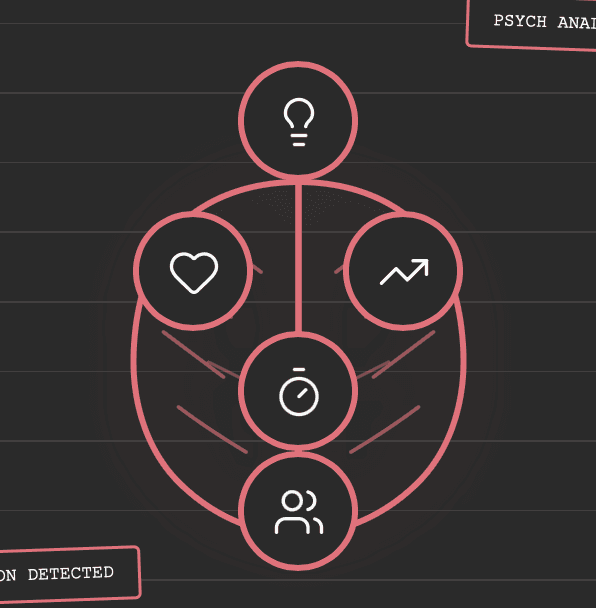
An interactive brain diagram allows users to explore bite-sized explanations of how advertisers exploit System 1 shortcuts like the Scarcity Principle or FOMO.
The Receipt Wall
A communal space where users see fake receipts for forgotten trends alongside lighthearted "confessions". This reframed overconsumption as something funny and widely shared, making regret feel less heavy.
Call to Action
"Take Back Control" Tools
The experience ends by handing control back to the user. After making the algorithm's cost feel personal, the final screen turns awareness into something the user can act on.
Call to Action
"Take Back Control" Tools
The experience ends by handing control back to the user. After making the algorithm's cost feel personal, the final screen turns awareness into something the user can act on.

Final Thoughts
Reflection & User Response
This project demonstrated that as a Product Designer, the most direct path to behavior change is often the least effective. By leading the cognitive research, I learned how to use humor and distancing to bypass the "resistance" that often kills persuasive interventions. We successfully moved from a "chore-like" tracking app to an experience where regret becomes communal and awareness becomes a form of agency.
Final Thoughts
Reflection & User Response
This project demonstrated that as a Product Designer, the most direct path to behavior change is often the least effective. By leading the cognitive research, I learned how to use humor and distancing to bypass the "resistance" that often kills persuasive interventions. We successfully moved from a "chore-like" tracking app to an experience where regret becomes communal and awareness becomes a form of agency.
Final Deliverables
Interactive Web Experience
In Memoriam is an interactive web experience, created in Figma, with assistance in prompting from Google Gemini and other AI systems.
View Project Demo ↗

Research Report
A research paper with research methods, cognitive science principles, user testing, and plans for future development.
View Research Report↗
More Works


FAQ
01
What kind of work are you looking for?
02
What makes your approach different?
03
Do you research or just design?
04
How do you work with AI?
05
Why is some of this academic work?
06
Can you actually build, or only design?
07
What tools do you work in?
08
How do I reach you?
2025
In Memoriam: Cognitive Persuasive Design
Using persuasive design to address digital overconsumption through a web-based experience. Challenging user perceptions of data tracking and targeted advertising.
Persuasive Design
Interactive Experience
Contributions
Role: Project Manager & Cognitive Research Lead
Team: Cameron Thompson, Camille Bove, Priyal Shrivastava, Uma Dhamija.
Timeline: 4 weeks (January - February 2026)
Tools: Figma, Figma Make
Live Demo
Explore the Trend Obituary for Yourself
Click the button below!
Persuasive Design
Explicit Persuasion Often Backfires
To build a truly persuasive tool, I directed the integration of five core psychological frameworks to move the project from explicit intervention to a subtle, "embedded" design.
Obfuscation
Concealing the persuasive intent behind wit and entertainment to maintain engagement and bypass resistance.
Social Proof
Positioning "privacy awareness" as a new, desirable peer standard while revealing how algorithms use social proof to manipulate purchasing.
Social Identity Theory
Encouraging users to dissociate from the "impulse buyer" group and adopt a more positive identity as an "aware consumer".
Using the "Receipt Wall" as a digital mirror to highlight discrepancies between a user's ideal standards and their actual consumption habits.
Elaboration Likelihood Method
Meeting users in System 1 (fast, automatic) with high-impact visuals before gradually transitioning to System 2 (slow, deliberate) reflection.
The Pivot
Issues with Data Personalization
A primary goal of my design leadership was ensuring the interaction model was non-belittling. We implemented a three-tiered input strategy to ensure the user felt in control regardless of their environment.
The Discovery
Our project originally centered on "Data Dolls"—personalized avatars dressed in items users were actually being targeted with via ads.
However, testing revealed that seeing their own inferred data didn't lead users to become more cognizant of their data privacy settings.
Instead, users found the dolls "cool," becoming more interested in the products. Alternatively, some users felt shamed.
The Strategic Shift
The "Data Dolls" triggered Psychological Reactance, where the perceived attempt to change attitudes caused users to put up psychological barriers.
We realized that distancing the user from their own data was actually more effective. We pivoted to a non-personalized, socially-grounded concept that reduced feelings of individual shame by framing trend-driven consumption as a shared cultural experience.
The Solution
A Narrative Journey
The "In Memoriam" experience turns familiar trend-chasing into a chance to pause, laugh, and reflect through a specific narrative arc.
The Trend Obituaries
We visualized the lifecycle of "dead" trends (e.g., Cottagecore) with "Death Graphs," pairing humorous epitaphs with data on financial and cultural impact. This turned abstract hype cycles into visible patterns users could recognize.
The Psychology Autopsy
An interactive brain diagram allows users to explore bite-sized explanations of how advertisers exploit System 1 shortcuts like the Scarcity Principle or FOMO.
The Receipt Wall
A communal space where users see fake receipts for forgotten trends alongside lighthearted "confessions". This reframed overconsumption as something funny and widely shared, making regret feel less heavy.
Call to Action
"Take Back Control" Tools
The experience ends by handing control back to the user. After making the algorithm's cost feel personal, the final screen turns awareness into something the user can act on.
Final Thoughts
Reflection & User Response
This project demonstrated that as a Product Designer, the most direct path to behavior change is often the least effective. By leading the cognitive research, I learned how to use humor and distancing to bypass the "resistance" that often kills persuasive interventions. We successfully moved from a "chore-like" tracking app to an experience where regret becomes communal and awareness becomes a form of agency.
Final Deliverables
Interactive Web Experience
In Memoriam is an interactive web experience, created in Figma, with assistance in prompting from Google Gemini and other AI systems.
View Project Demo ↗
Research Report
A research paper with research methods, cognitive science principles, user testing, and plans for future development.
View Research Report↗
More Works
FAQ
01
What kind of work are you looking for?
02
What makes your approach different?
03
Do you research or just design?
04
How do you work with AI?
05
Why is some of this academic work?
06
Can you actually build, or only design?
07
What tools do you work in?
08
How do I reach you?
2025
In Memoriam: Cognitive Persuasive Design
Using persuasive design to address digital overconsumption through a web-based experience. Challenging user perceptions of data tracking and targeted advertising.
Persuasive Design
Interactive Experience
Contributions
Role: Project Manager & Cognitive Research Lead
Team: Cameron Thompson, Camille Bove, Priyal Shrivastava, Uma Dhamija.
Timeline: 4 weeks (January - February 2026)
Tools: Figma, Figma Make
Live Demo
Explore the Trend Obituary for Yourself
Click the button below!
Persuasive Design
Explicit Persuasion Often Backfires
To build a truly persuasive tool, I directed the integration of five core psychological frameworks to move the project from explicit intervention to a subtle, "embedded" design.
Obfuscation
Concealing the persuasive intent behind wit and entertainment to maintain engagement and bypass resistance.
Social Proof
Positioning "privacy awareness" as a new, desirable peer standard while revealing how algorithms use social proof to manipulate purchasing.
Social Identity Theory
Encouraging users to dissociate from the "impulse buyer" group and adopt a more positive identity as an "aware consumer".
Using the "Receipt Wall" as a digital mirror to highlight discrepancies between a user's ideal standards and their actual consumption habits.
Elaboration Likelihood Method
Meeting users in System 1 (fast, automatic) with high-impact visuals before gradually transitioning to System 2 (slow, deliberate) reflection.
The Pivot
Issues with Data Personalization
A primary goal of my design leadership was ensuring the interaction model was non-belittling. We implemented a three-tiered input strategy to ensure the user felt in control regardless of their environment.
The Discovery
Our project originally centered on "Data Dolls"—personalized avatars dressed in items users were actually being targeted with via ads.
However, testing revealed that seeing their own inferred data didn't lead users to become more cognizant of their data privacy settings.
Instead, users found the dolls "cool," becoming more interested in the products. Alternatively, some users felt shamed.
The Strategic Shift
The "Data Dolls" triggered Psychological Reactance, where the perceived attempt to change attitudes caused users to put up psychological barriers.
We realized that distancing the user from their own data was actually more effective. We pivoted to a non-personalized, socially-grounded concept that reduced feelings of individual shame by framing trend-driven consumption as a shared cultural experience.
The Solution
A Narrative Journey
The "In Memoriam" experience turns familiar trend-chasing into a chance to pause, laugh, and reflect through a specific narrative arc.
The Trend Obituaries
We visualized the lifecycle of "dead" trends (e.g., Cottagecore) with "Death Graphs," pairing humorous epitaphs with data on financial and cultural impact. This turned abstract hype cycles into visible patterns users could recognize.
The Psychology Autopsy
An interactive brain diagram allows users to explore bite-sized explanations of how advertisers exploit System 1 shortcuts like the Scarcity Principle or FOMO.
The Receipt Wall
A communal space where users see fake receipts for forgotten trends alongside lighthearted "confessions". This reframed overconsumption as something funny and widely shared, making regret feel less heavy.
Call to Action
"Take Back Control" Tools
The experience ends by handing control back to the user. After making the algorithm's cost feel personal, the final screen turns awareness into something the user can act on.
Final Thoughts
Reflection & User Response
This project demonstrated that as a Product Designer, the most direct path to behavior change is often the least effective. By leading the cognitive research, I learned how to use humor and distancing to bypass the "resistance" that often kills persuasive interventions. We successfully moved from a "chore-like" tracking app to an experience where regret becomes communal and awareness becomes a form of agency.
Final Deliverables
Interactive Web Experience
In Memoriam is an interactive web experience, created in Figma, with assistance in prompting from Google Gemini and other AI systems.
View Project Demo ↗
Research Report
A research paper with research methods, cognitive science principles, user testing, and plans for future development.
View Research Report↗
More Works
FAQ
What kind of work are you looking for?
What makes your approach different?
Do you research or just design?
How do you work with AI?
Why is some of this academic work?
Can you actually build, or only design?
What tools do you work in?
How do I reach you?